Boat Stabilizers: Flopper Stoppers and More
Boat stabilizers reduce side-to-side roll when a boat is anchored or moored in chop, wakes, tide surge, or passing boat traffic. These marine stabilization devices help anglers, cruisers, liveaboard boaters, and overnight guests improve comfort and reduce fatigue while the vessel is stationary.
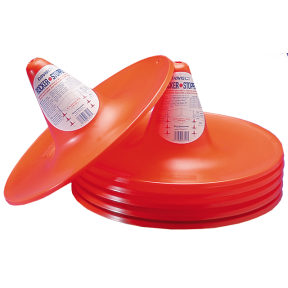
Fisheries Supply offers stationary roll-control products from established marine brands, including the Forespar Roll-X Flopper Stopper and the Davis Instruments Rocker Stopper.
Boat Stabilizer Key Takeaways
- Boat stabilizers reduce rolling and rocking caused by waves, wind, current, wakes, and tide surge.
- Flopper stoppers are designed primarily for boats at anchor or on a mooring.
- Boat length, displacement, deck configuration, operating conditions, and budget affect stabilizer selection.
- Flopper stopper performance depends on correct sizing, pole placement, rigging, and deployment.
- Forespar Roll-X kits and Davis Instruments Rocker Stoppers provide different approaches to stationary roll reduction.
Understanding Boat Stabilizers
Boat stabilizers are devices or systems that reduce rolling and rocking motion caused by waves, wind, current, wakes, or nearby boat traffic. Stabilization options range from straightforward mechanical devices for stationary boats to more complex hydrodynamic or gyroscopic systems intended for larger vessels or operation underway.
The appropriate system depends on the boat’s size, hull type, operating environment, stabilization goals, and available budget. A passive mechanical device designed specifically for use at anchor should never be deployed while the vessel is moving, as hydrodynamic drag can damage the hull, rigging, or hardware.
Boat Stabilizer Types and Uses
| Stabilizer Type | Primary Use | Key Consideration |
|---|---|---|
| Flopper stopper | Reducing roll while anchored or moored | Requires dedicated structural poles, high-leverage suspension, and proper stay rigging to handle severe upward lifting forces. |
| Rocker stopper | Providing straightforward stationary roll control | Quantity, spacing, and a suitable terminal bottom weight must match the vessel's length and displacement. |
| Advanced stabilization system | Supporting larger boats or stabilization underway | System complexity, continuous power requirements, and cost are significantly higher than passive mechanical devices. |
Flopper Stoppers for Boats at Anchor
Flopper stoppers are mechanical roll stabilizers intended for stationary boats. The device descends through the water column with relatively little resistance, then resists rapid upward movement when a wave lifts the vessel. That physical resistance interrupts the hull’s natural rolling rhythm and dramatically reduces side-to-side motion.
Flopper stoppers are commonly deployed from specialized stabilizer poles extending perpendicular to the boat’s centerline. A balanced two-sided arrangement allows one unit to resist upward movement while the unit on the opposite side descends, transferring the dampening force directly to the vessel's structure.
How Flopper Stoppers Work
| Stage | How It Works |
|---|---|
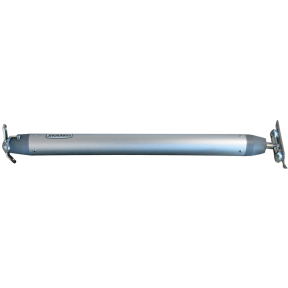
| Deployment from Stabilizer Poles | Flopper stoppers are suspended from the ends of dedicated stabilizer poles positioned outward from each side of the boat to maximize mechanical leverage and keep the hardware isolated from the hull. |
| Resistance to Upward Motion | As the hull begins to roll, the submerged device on the rising side resists upward movement via high surface-area drag. The opposite device sinks freely, creating a counteracting cycle that reduces the speed and extent of the roll. |
| Rigging and Support | Stabilizer poles require heavy-duty mounting hardware and supporting stays. Forespar Roll-X kits provide the structural poles and base hardware; however, the critical topping lift line and fore/aft control stays must be rigged separately with high-tensile marine lines. |
How to Choose a Boat Stabilizer
Select a boat stabilizer by matching the system to the vessel, the operating environment, and the type of motion control required.
- Confirm the operating mode: Determine whether stabilization is needed at anchor, on a mooring, underway, or in more than one condition.
- Match the boat size and displacement: Use a stabilizer configuration engineered explicitly for the vessel’s overall length, air draft, and displacement range.
- Review the hull and deck layout: Confirm that hull sockets, pad eyes, stays, and deployment lines can be positioned without obstructing normal deck operations or causing high-load structural deflection.
- Consider local conditions: Account for heavy chop, wakes, current, tide surge, wind exposure, and passing boat traffic.
- Evaluate installation requirements: Marine professional installation is highly recommended for load-bearing hull and deck hardware, while basic rigging assembly can often be managed by the boat owner.
- Compare system complexity: Passive mechanical stabilizers generally provide a simpler, power-free option compared to advanced active stabilization systems.
Forespar and Davis Roll Stabilizers
| Roll Stabilizer | Boat Size or Use | Included Components and Requirements |
|---|---|---|
| Forespar Roll-X Flopper Stopper | Available in two configurations: a Small Kit for boats up to 40 feet (utilizing an 11-foot aluminum pole) and a Large Kit for boats from 40 to 55 feet (utilizing a 14-foot aluminum pole). | The kits include 304 electropolished stainless steel resistance plates, dedicated aluminum stabilizer poles, and hull mounting sockets. Supporting load-bearing topping lifts and fore/aft stabilization stays must be supplied and rigged separately. |
| Davis Instruments Rocker Stopper | Designed to reduce roll while a boat is stationary, engineered for modular scalability on vessels up to 50 feet. | Constructed of high-impact salt-resistant plastic (14-inch diameter discs). Requires a user-supplied 5 to 10 lb bottom weight (such as a mushroom anchor) and a 3/8-inch braided or three-strand line to anchor and nest the units. |
Frequently Asked Questions
What type of boat stabilizer works while anchored or moored?
Flopper stoppers and rocker stoppers are designed to reduce roll while a boat is anchored or moored. These mechanical stabilizers resist vertical movement in the water column and interrupt the hull’s rolling rhythm. They are intended exclusively for stationary use rather than stabilization while the vessel is traveling.
How does a flopper stopper reduce boat roll?
A flopper stopper descends through the water with limited resistance and resists rapid upward movement as the boat rolls. Forespar's engineered plate utilizes a specialized flat profile to eliminate lateral underwater "skating." When units are deployed on both sides, their alternating resistance slows the rising side of the hull and dampens side-to-side rocking at anchor.
What roll stabilizers does Fisheries Supply carry?
Fisheries Supply carries Forespar Roll-X Flopper Stopper Pole Kits for boats up to 40 feet and for boats from 40 to 55 feet. Fisheries Supply also offers the Davis Instruments Rocker Stopper, a modular mechanical option for stationary roll reduction.
Do Forespar Roll-X flopper stoppers require separate stays?
Yes, Forespar Roll-X pole installations require supporting stays that are not included with the kit. The kit provides stabilizer poles, plates, and mounting sockets. The user must rig fore and aft control stays to stop pole swing, alongside a critical load-bearing topping lift fixed to a point on the mast or superstructure at least 8 feet above the pole height to handle the upward forces.
Can a boat owner install a flopper stopper system?
Many boat owners can rig and deploy a mechanical flopper stopper system when they have moderate mechanical skills and basic boating experience. The work involves assembling lines, setting deployment depths, and adjusting stays. Because mounting the hull sockets introduces high leverage loads, professional marine installation is highly recommended for securing the base hardware safely.
How do I choose the correct boat stabilizer size?
Choose a boat stabilizer by matching the vessel's specific characteristics to manufacturer guidelines. For the Forespar Roll-X system, select the Small Kit (11' pole) for boats up to 40 feet or the Large Kit (14' pole) for boats from 40 to 55 feet. For the Davis Rocker Stopper system, string multiple units spaced 18 inches apart on each side based on length: 3 units per side for boats up to 26 ft; 4 units per side for 27 to 36 ft; 5 units per side for 37 to 42 ft; and 8 units per side for boats up to 50 ft.