Velair VSD Inverter-Driven Marine Air Conditioners
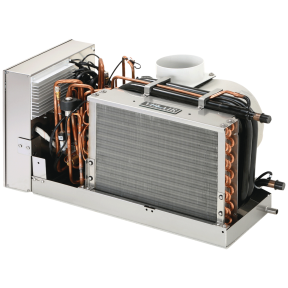
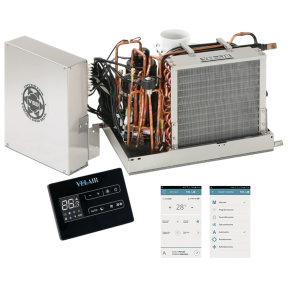
The Velair VSD inverter-driven air conditioning system provides efficient, quiet climate control for boat owners upgrading a marine air conditioner. Its variable-speed compressor and fan operation supports small boats, larger vessels, individual staterooms, and multiple open cabins. Velair VSD is a self-contained marine air conditioning system designed for onboard cooling. Inverter-driven technology dynamically adjusts compressor and fan speeds based on cooling demand, reducing power consumption, eliminating startup current spikes, lowering operating noise, and reducing temperature fluctuations compared with traditional systems that cycle at full power.
Velair VSD Buying Takeaways
Why Choose a Velair VSD Marine Air Conditioner?
Velair VSD Features and Benefits
| Feature | Technology or Design | Benefit |
|---|---|---|
| Energy Efficiency | Inverter-driven technology adjusts output instead of operating continuously at full power. | Reduces unnecessary energy consumption as cooling demand changes. |
| Compact Design | Space-conscious, self-contained chassis. | Supports installation where onboard space is limited. |
| Cooling Capacity | Multiple capacity options ranging from compact 10,000 BTU units to 21,000+ BTU models. | Accommodates smaller spaces, larger vessels, and multiple open cabins. |
| Quiet Operation | Variable-speed components adjust as cooling demand changes. | Reduces onboard noise disruption. |
| Consistent Temperature Control | Dynamic compressor and fan speed adjustments. | Responds to changing cabin cooling requirements. |
| Marine Durability | Construction designed for marine operating conditions. | Supports regular onboard use. |
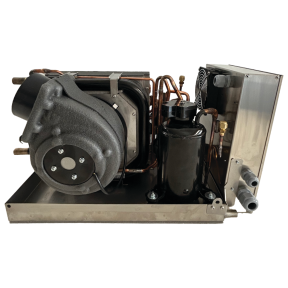
| Simplified Service Access | Primary components are housed on one self-contained chassis. | Makes system components easier to access for inspection and service. |
How to Select a Marine Air Conditioner
| Selection Factor | What to Evaluate | Why It Matters |
|---|---|---|
| Cabin volume and location | Multiply length, width, and height (in feet) to find cubic volume, then apply standard marine multipliers: 15 BTU/cu ft for below-deck cabins, 18-20 BTU/cu ft for main-deck saloons, and up to 25 BTU/cu ft for glass-heavy helms or tropical climates. | Provides an accurate baseline for selecting required cooling capacity based on thermal exposure. |
| Window area and insulation | Review window size and the cabin's insulation. | Heat gain and insulation quality can change the final BTU requirement. |
| Climate | Consider the local temperatures and typical boating conditions. | Warmer climates may create greater cooling demand. |
| Cabin layout | Identify individual staterooms, connected open cabins, and airflow restrictions. | Cooling capacity should match the interior layout rather than boat length alone. |
| Installation space | Confirm that the available location can accommodate a self-contained marine air conditioner. | The unit must fit while leaving room for airflow, ducting, connections, and service access. |
| Power compatibility | Review available shore power, inverter, or generator capacity. | The onboard power source must support the marine air conditioner's electrical demand. |
| Air and seawater circulation | Plan return-air circulation and overboard seawater discharge. | Proper airflow and seawater flow support effective system operation. |
| Maintenance access | Allow access to the return-air filter, seawater strainer, pump, and cooling coils. | Accessible components simplify routine inspection, cleaning, and service. |
Marine Air Conditioner Applications
Velair VSD systems can support climate control aboard small boats and luxury yachts. Common applications include replacing an older split system, upgrading a traditional cycling boat air conditioner, cooling an individual stateroom, or managing connected cabin spaces with an appropriately sized unit. When replacing a split system with a self-contained unit, ensure adequate space for high-volume supply ducting and return airflow pathways.
Contact Fisheries Supply representatives for help selecting a Velair VSD marine air conditioner based on cabin size, vessel layout, power source, and installation space.
Frequently Asked Questions
What is a Velair VSD inverter-driven marine air conditioner?
A Velair VSD is a self-contained marine air conditioner that dynamically adjusts compressor and fan speeds. Variable-speed operation reduces energy consumption, operating noise, startup current spikes, and temperature fluctuations, making the system suitable for boat owners replacing traditional marine AC equipment or planning a new cabin cooling installation.
How do I determine the correct BTU size for my boat's air conditioner?
Calculate cabin volume by multiplying length, width, and height in feet. Then, multiply cubic volume by 15 for below-deck staterooms, 18-20 for main-deck saloons with glass windows, or up to 25 for tropical climates and flybridges. Window area, insulation, local climate, and connected cabin spaces also affect total required capacity.
What advantages does a VSD system have over traditional marine AC?
A VSD marine air conditioner adjusts compressor and fan speeds instead of repeatedly cycling at full power. This supports quieter operation, more consistent temperature control, lower energy use, and eliminates startup inrush spikes. The soft-starting capability places significantly less strain on a boat's generator, inverter, or shore power connection.
What maintenance does a marine air conditioner require?
Clean return-air filters at least monthly, inspect the seawater strainer for debris, and check the overboard discharge for steady water flow. Periodically inspect the cooling circuit and flush seawater coils annually with a mild marine descaling solution to limit mineral and growth buildup.
Why does a marine AC display LO, PS, or HI-P error codes?
These error codes indicate a protective system shutdown. LO commonly identifies low supply voltage from the shore power source, generator, or DC bus. HI-P or PS points to high refrigerant pressure, most frequently caused by restricted seawater cooling from a clogged strainer, air-locked pump, or fouled heat exchanger.
Can a Velair VSD self-contained unit replace an older split system?
Yes, a Velair VSD self-contained unit can replace an older split system when the installation space, power supply, seawater circuit, and cooling capacity are compatible. Unlike split systems, a self-contained air conditioner houses all components on one chassis, requiring adequate space for main supply ductwork and return-air airflow.