Boat Trailer Jacks and Trailer Jack Accessories
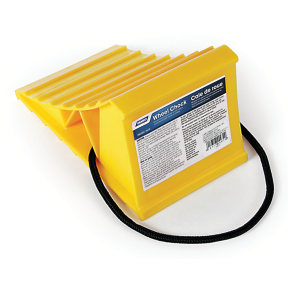
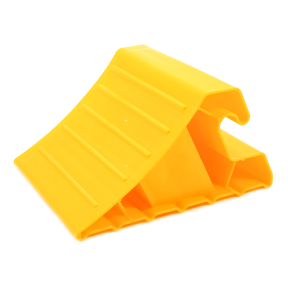
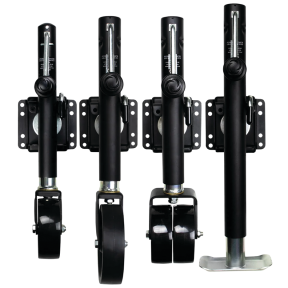
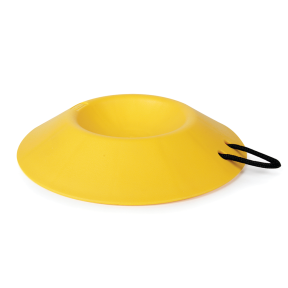
Boat trailer jacks lift and support a trailer tongue for safer hitching, unhitching, positioning, and storage. Fisheries Supply carries swivel tongue jacks, drop-leg trailer jacks, wheeled marine jacks, wheel chocks, and wheel docks for boat trailer maintenance projects.
Choosing a Boat Trailer Jack
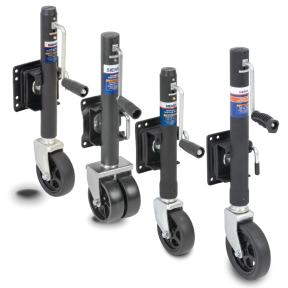
The correct marine trailer jack must match the trailer tongue weight, required lift range, mounting configuration, towing clearance, and operating surface. Wheeled jacks support manual positioning on flat pavement, while drop-leg designs provide added lift range for heavier trailers or uneven ground.
Types of Boat Trailer Jacks
Boat Trailer Jack Selection Factors
| What to Look For | What to Check |
|---|---|
| Rated lift capacity | The jack rating must exceed the supported trailer tongue weight. |
| Vertical travel | The operating range must raise the coupler above the hitch ball and support trailer leveling. |
| Mounting configuration | Confirm compatibility with a straight trailer tongue, A-frame, bolt-on bracket, or weld-on installation. |
| Retracted clearance | Check that the stored jack remains clear of the road during towing. |
| Handle clearance | Allow enough space for a side-wind or top-wind handle to rotate without contacting trailer hardware. |
| Ground conditions | Wheels work on firm surfaces; wheel docks or stable bases help distribute weight on softer ground. |
| Corrosion resistance | Zinc-plated components and routine freshwater rinsing support marine trailer use. |
Featured Curt Manufacturing Marine Jack
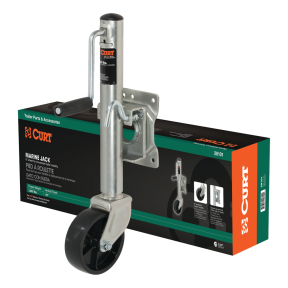
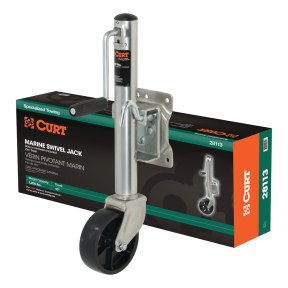
The Curt Manufacturing 8-inch Wheel Marine Jack combines a wheeled design with a zinc-plated finish for boat trailer positioning and coupling.
| Specification | Product Detail | Why it Matters |
|---|---|---|
| Lift capacity | 1,500 lbs. | Supports compatible trailer tongue loads within the manufacturer rating. |
| Vertical travel | 10 inches | Provides lifting range for coupling, uncoupling, and positioning. |
| Wheel diameter | 8 inches | Supports manual trailer movement on suitable firm surfaces. |
| Finish | Zinc-plated | Provides corrosion resistance for marine trailer applications. |
Trailer Jack Accessories
Boat Trailer Jack Brands
- Curt Manufacturing marine jacks: Wheeled trailer jacks with specified lift capacities, travel ranges, and corrosion-resistant finishes.
- Camco trailer accessories: Wheel chocks and wheel docks for trailer stability and ground support.
Marine Trailer Jack Care
- Rinse the jack with fresh water after saltwater exposure.
- Inspect the mounting hardware, pivot mechanism, wheel, handle, and fasteners.
- Clean and lubricate internal screw threads and bearings with compatible marine-grade water-resistant grease.
- Check zinc-plated surfaces for corrosion, wear, or coating damage.
- Replace damaged components before lifting or supporting the trailer tongue.
Frequently Asked Questions
How do I choose the right boat trailer jack for my trailer?
Choose a boat trailer jack with a rated lift capacity above the trailer tongue weight. Confirm compatibility with the tongue shape, mounting location, required travel, and handle clearance. The jack must also retract far enough to provide suitable road clearance when the trailer is connected to the tow vehicle.
How much lift capacity does a boat trailer jack need?
A boat trailer jack must support the trailer tongue weight, not the complete boat and trailer weight. Tongue weight is commonly 10~15% of the combined loaded weight, but the actual value should be measured. Select a jack rating above that measured load and follow the trailer and jack manufacturer requirements.
What is the difference between a swivel jack and a drop-leg jack?
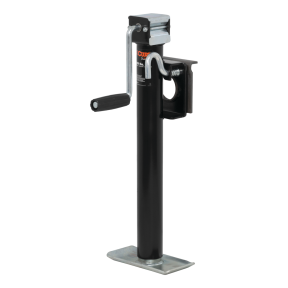
A swivel jack pivots parallel to the trailer frame for added towing clearance. A drop-leg jack uses an adjustable inner tube that lowers toward the ground before cranking begins. Drop-leg designs reduce cranking time and commonly provide more lift range for heavier trailers or uneven operating surfaces.
Should I choose a trailer jack with a wheel or foot plate?
Choose a wheeled trailer jack when a smaller or mid-sized boat trailer must be moved manually on flat, firm ground. Choose a foot plate when stability and weight distribution matter more than mobility. Soft or uneven surfaces may also require a wheel dock or another compatible support base.
How do I measure the required trailer jack lift height?
Measure the coupler height when the trailer is level, then compare it with the hitch-ball height and the jack's extended and retracted dimensions. The available vertical travel must raise the coupler above the hitch ball for uncoupling while leaving enough adjustment range to level and support the trailer.
How should a marine trailer jack be maintained after saltwater use?
Rinse the marine trailer jack with fresh water after saltwater exposure, then inspect the wheel, fasteners, pivot, handle, and finish. Periodically clean and lubricate the internal screw threads and bearings with compatible marine-grade water-resistant grease. Replace corroded, bent, loose, or damaged components before operating the jack.