Premier Fishfinders and Boat Transducers
Fisheries Supply is a good source for high-resolution fishfinders, GPS-enabled displays, and boat transducers. Our inventory covers complete sonar and navigation solutions, from standalone units to integrated chartplotter fishfinders.
What To Know
- Fishfinders and transducers work as a matched system.
- Mounting style affects sonar performance and installation complexity.
- Integrated GPS fishfinders support both navigation and fishing.
- Product selection should match boat size, hull type, and water depth.
In addition to GPS fishfinders, we stock transom-mount and thru-hull transducers, and compatible accessories to support clean, reliable installations on a wide range of boats.
Explore Our Range of Fishfinders and Chartplotters
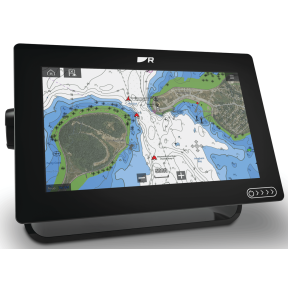
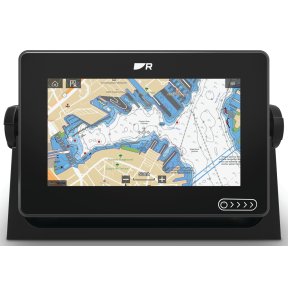
- Chartplotter Fishfinder GPS Units: Integrated displays that combine navigation charts with real-time sonar data for efficient route planning and fish tracking.
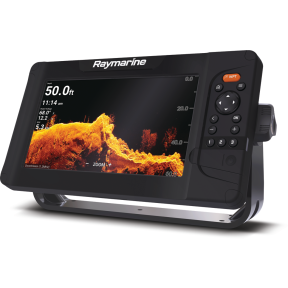
- GPS Fishfinders: Fishfinding systems with built-in GPS functionality, supporting waypoint marking and position awareness.
- Boat GPS Fishfinders: Dual-purpose systems designed for anglers who rely on both accurate navigation and dependable sonar returns.
- Fishfinder Chartplotters: Multifunction displays that merge sonar, GPS, and charting into a single, streamlined interface.
- Fishfinders: A range of models from entry-level to advanced, suitable for casual fishing through professional use.
- Fishfinder Transducers: Transom-mount and thru-hull options that deliver clear readings of depth, structure, and fish targets.
Enhance Your Fishing Experience
Selecting the right fishfinder and matching transducer plays a major role in system accuracy and overall performance. Properly paired components help deliver clearer target separation, more reliable depth readings, and easier interpretation of underwater conditions.
From professional anglers to weekend boaters, these tools support better decision-making on the water. With dependable electronics installed correctly, you can focus less on guesswork and more on fishing.
Browse our inventory ofboat GPS displays to compare features and find the right fit for your boat.
Frequently Asked Questions
What are the common mounting options for fishfinder transducers?
Common mounting options include transom mounts for smaller boats, thru-hull mounts for larger boats or displacement hulls, and in-hull mounts where external installation is not preferred.
What is CHIRP technology in fishfinders?
CHIRP, or Compressed High-Intensity Radar Pulse, transmits a range of frequencies rather than a single frequency. The combined return produces clearer images with improved target separation and depth performance compared to traditional sonar.
What is the difference between 50 kHz and 200 kHz transducer frequencies?
Transducer frequency determines depth capability and detail. A 200 kHz frequency provides high-detail images and is ideal for shallow water (typically less than 600 feet), while a 50 kHz frequency has a wider beam and better penetration for tracking bottom in deeper, offshore waters.
When should I use a thru-hull mount versus a transom mount transducer?
Thru-hull mounts are ideal for larger vessels and provide the best performance by staying in clean water flow, though they require a hole in the hull. Transom mounts are more common for smaller boats, as they are easier to install on the exterior of the stern and do not require drilling through the bottom of the boat.
What is the purpose of a transducer fairing block?
A fairing block is used when mounting a thru-hull transducer on a curved or angled hull. It allows the transducer to be oriented straight down (perpendicular to the water's surface) while creating a streamlined flow of water around the sensor to reduce turbulence and improve sonar accuracy at higher speeds.
Do fishfinders always include a transducer in the box?
Not always. While many entry-level fishfinder bundles include a transom-mount transducer, many high-end multifunction displays and chartplotters are sold as "head units only." This allows boaters to select a specific thru-hull, in-hull, or CHIRP transducer that best matches their hull material and fishing needs.
Can I use a bronze transducer on an aluminum hull?
No, you should never use a bronze transducer on an aluminum hull because it will cause galvanic corrosion. For aluminum or steel hulls, you should select a stainless steel or plastic/synthetic transducer to prevent damage to the vessel.