Protect Your Boat with AIS (Automatic Identification System)
What if there was a technology out there that not only allowed you to immediately identify the name, course, and speed of the boats around you – but also told you how close they will come to you and how much time you have to avoid
them – would you buy it? That technology exists and it's called AIS (Automatic Identification System).
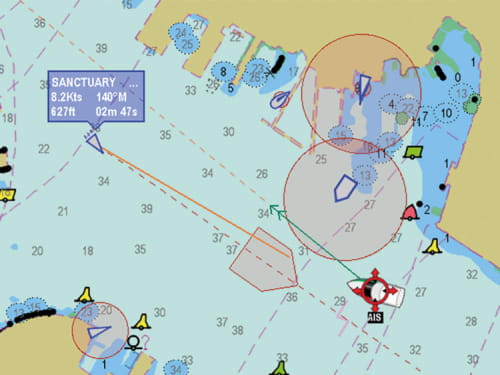
With an AIS transceiver installed, you can receive all that information overlaid right on your chart plotter – allowing you to simply click on each boat to view the AIS data you need to avoid a collision.
Like most modern technologies, AIS comes
with a mind-boggling array of configurations that are sure to confuse most recreational boaters. In this article, we will break down the various AIS options to help you understand which ones may be the most suitable for your
needs.
What Exactly is AIS and How Does it Work?
Automatic Identification Systems (AIS) use VHF frequencies to transmit AIS information messages that contain parcels of data to help vessels avoid collisions with boats that have been outfitted with their technology. When AIS is installed on a boat, the unit collects position and timing information of the boat from an external or integrated GPS receiver and then, using VHF, broadcasts out the location, vessel speed and course, vessel name and other bits of information to any other boats or land-based organizations in the vicinity, within radio range, that have an AIS receiver installed. Any boat with AIS can view the transmission on a screen, often overlaid on charting software, to easily see where other boats are in relation to their own location. AIS also provides valuable information about CPA (Closest Point of Approach) so that you'll know just how close that vessel will come to you if you both keep your current headings, along with TCPA – which is how much time you have before you reach that CPA. Information that once took complicated formulas with multiple measurements off a radar is now literally at our fingertips any time we want to take a look. Even better, AIS creates alarms to warn you when the TCPA is reaching a critical point and you are in immediate danger. AIS makes boating safer.
The Classes of AIS:
When looking at AIS devices, you will notice that they are classified as either Class A, Class B+ or Class B for enhanced navigation and vessel tracking systems. Before buying an AIS system, it is important to know which Class is appropriate for your boat.
Class A – Starting in 2002, Class A AIS units became required for all ships over 300 gross tons, and for all passenger ships regardless of size. These units transmit and receive information using SOTDMA (see below), which can transmit every 2-3 seconds and feature sophisticated software that helps determine when to transmit (and how often) based on whether the ship is moving or anchored. Class A units transmit at 12.5 watts, so can be received from up to 20-25 nautical miles away and will transmit more often the faster the vessel is moving. They are required to include an integrated display with keyboard and in addition to transmitting more frequently, then send considerably more information than a B or B+ unit.
Class B+ - Like the Class A, the "Class B+" transmits using SOTDMA – but only at 5 watts, so transmissions will be limited to approximately 10-12 nautical miles away. Also like Class A, the frequency of transmissions will be determined by how fast the vessel is moving – so the faster the speed, the more frequent the transmission along with guaranteed transmissions. For slow-moving non-commercial vessels, this is not as important, but if you run your recreational boat at 20 knots or higher, you should seriously consider Class B+ over Class B AIS transponders.
Class B – These units are sold as receive only or as receive and transmit – using a CSTDMA transponder. These transponders transmit at just 2 watts – giving them a range of approximately 7-8 nautical miles – and send transmissions about every 30 seconds (assuming a slot is available). Class B devices are meant for recreational vessels that cruise at slower speeds. If your boat travels at a slow speed (e.g., less than 15 knots), a smaller transmission range and less frequent transmission rate is perfectly acceptable.
Receive Only – These units will only receive, read and display information about the vessels that are transmitting nearby. It will not transmit the location of the vessel it's on. Some recreational vessels have chosen this as an option as it gives excellent information while being slightly more economical.
SOTDMA vs. CSTDMA
SOTDMA stands for Self-Organized Time Division Multiple Access. This technology allows up to 4500 ships to work in proximity of each other by figuring out which ships are in each other's path and giving them priority transmissions. The SOTDMA broadcast mode enables ships that are moving faster to transmit more frequently than slower ships, as the faster ship's position changes quickly and thus needs to be updated more often. SOTDMA transmissions are guaranteed and take place every 26.6 milliseconds, so there are usually more than enough transmission slots to safely report the location of all the vessels in the area. Both "A" and "B+" classes utilize SOTDMA technology.
CSTDMA stands for Carrier Sense Time Division Multiple Access. This technology listens for SOTDMA transmissions and grabs any empty time slots available in between those transmissions to transmit it's information. Class A and B+ transmissions will always have priority over any CSTDMA transmissions. While not guaranteed, with transmissions happening every 26.6 milliseconds, there are usually plenty of slots to be had for all vessels in one location. CSTDMA units will only transmit approximately every 30 seconds – so if you have a very fast-moving vessel (over 20 knots), you should consider a Class B+ unit.
Because of these differences, the number of transmissions a vessel will make greatly depends on its class, whether it's anchored, underway, or maneuvering, with each affecting its navigational status. All Class A and B+ transmissions will take priority over class B transmissions, based on their navigational status. In addition, a fast-moving Class A vessel will transmit its position every couple of seconds. A Class B+ vessel moving at 20 knots may transmit every 7-10 seconds while a Class B recreational vessel will likely only transmit about every 30 seconds – and only if there is a time slot available.
If a boat is at a range, in a bearing, and at a speed that could pose a collision risk, it will trigger an alarm, be highlighted in red, and become pinned on the screen. This feature lets you see more details about the target and take action to change course or communicate with the other vessel. Integrating AIS with your chartplotter enables you to view multiple targets within range and track them on the map.
Terrestrial-based AIS (T-AIS)
Terrestrial-based AIS, also known as T-AIS, involves a network of AIS base stations that receive and relay AIS signals from vessels in proximity. These AIS base stations operate on VHF radio channels and play a vital role in enhancing maritime safety. The transmission power of these base stations ensures that data is communicated effectively, with coverage extending to several nautical miles.
By deploying strategically placed base stations, T-AIS enhances vessel tracking capabilities, particularly in busy waterways and coastal regions. These stations can relay AIS data to traffic control centers, helping authorities monitor maritime traffic and respond swiftly to emergencies. Furthermore, T-AIS systems are crucial for supporting vessel traffic services, enabling more effective management of shipping lanes and navigation.
Satellite-based AIS (S-AIS)
Satellite-based AIS, or S-AIS, expands the reach of AIS technology beyond terrestrial limitations. This system utilizes satellites to collect AIS signals from vessels, enabling tracking even in remote oceanic regions. The ability to receive signals from all types of vessels, including smaller crafts that may not be equipped with advanced navigation systems, enhances safety on open seas.
S-AIS plays a crucial role in collision avoidance by providing essential data, such as the MMSI number, vessel identity, and position. This information is relayed to maritime authorities, facilitating effective monitoring of vessel movements and improving overall maritime safety. In essence, S-AIS complements terrestrial AIS by filling coverage gaps and ensuring that vessels are visible to authorities, regardless of their location.
Why does the VHF Antenna Matter?

AIS transponders use a VHF antenna to make their transmissions – so the functions of AIS are only as good as the VHF antenna it's attached to. There are two options when installing AIS – one is to install a dedicated VHF antenna for the AIS unit, and the 2nd is to install a "low loss" splitter which allows you to use one VHF antenna for both your radio and AIS unit. Some newer units already come with a splitter installed, so it's essential to understand what the unit includes.
Why would you install two antennas when one will do? Because in a shared antenna environment the AIS will only transmit when the VHF radio is not in use – so if you are talking on the VHF, the AIS will not transmit. For the most part this situation will be fine – but in some situations, such as when there's a man overboard or a serious issue with an approaching boat, it may be VERY important that the AIS continues to transmit your location while you communicate with another vessel. If you only have one antenna, this can be dealt with by using a handheld VHF so that your AIS can still transmit. But you can avoid this issue altogether by installing a dedicated VHF antenna for each piece of equipment.
If you do decide to install a dedicated antenna for your AIS system, it's important to note that the antenna can NOT be located next to your radio antenna – so 2 antennas at the top of the mast is not a option. The AIS antenna needs to be located at least 4 feet away from any other VHF antenna and should be at least 10 feet above the water. Since the AIS transmissions are operating via VHF line-of-sight – the higher you locate the AIS antenna, the further you will be able to transmit and receive.
Data Transmitted via AIS
The AIS system transmits various types of data that are crucial for safe navigation. This data can be categorized into static, dynamic, and voyage-related messages. Static data includes vital information about the vessel, such as its name, type, and size, while dynamic data encompasses real-time updates like position, speed, and heading. Voyage-related data provides additional context, including the vessel's destination and estimated time of arrival (ETA). Below is a summary of the types of AIS data:
|
Data Type |
Description |
|---|---|
|
Static Data |
Vessel details: name, call sign, MMSI number, type, and size. |
|
Dynamic Data |
Current information: position (latitude and longitude), speed, and course. |
|
Travel-Related Data |
Navigation details: port of destination, ETA, and cargo specifications. |
This comprehensive exchange of AIS messages not only aids in vessel tracking but also plays a significant role in collision avoidance by providing all parties with relevant navigational information.
Taking AIS to an Even Better Place
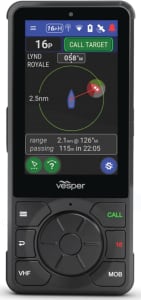
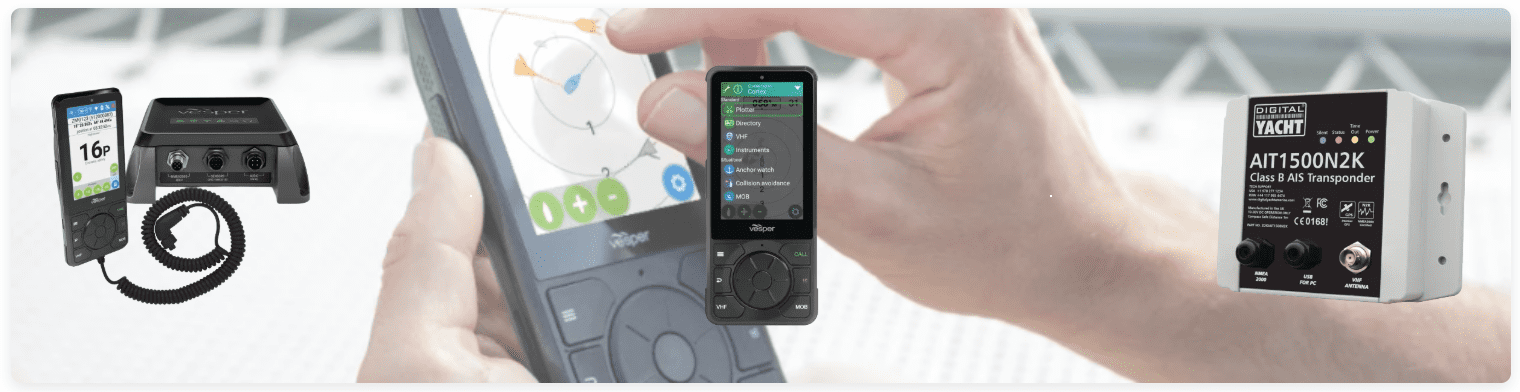
While virtually ALL the well-known marine electronics manufacturers are now offering their own AIS transponders for recreational boaters, a couple of manufacturers are taking AIS and its abilities to a whole new level. By utilizing NMEA connections, some brands, such as Vesper Marine, are creating devices that not only provide full AIS functionality but also integrate other information offered by your electronics, including wind speed, water depth, GPS alarms for anchoring, battery monitoring, and more. Add in a Wi-Fi connection and suddenly you can monitor these things from anywhere in the world – on or off your boat. With Vesper Marine's Cortex system, you get a Class B+ transponder and a handheld VHF with a touchscreen monitor that not only displays targets and allows you to place DSC calls directly to any boat in the area with a touch of a button – but also allows you to connect any NMEA device onboard for easy monitoring. Connect it to Wi-Fi and you also get an anchor watch system for when you're away from the boat.
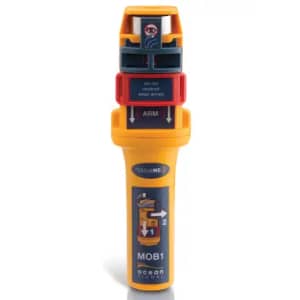
One other exciting development with AIS is the availability of wearable AIS beacons that you attach to your life jacket – often referred to as AIS MOB. When activated, these devices will transmit the location of the man overboard to any AIS receivers within approximately 4 miles – making retrieval of a crewmember significantly easier in rough seas. At Fisheries Supply we offer several of these MOB Personal Rescue Beacons, including the AISLink or OLAS from ACR Electronics, or the rescueME from Ocean Signal.
It's clear that the future holds exciting advances for the recreational boater – but one thing that cannot be denied is that if you can afford it, there's absolutely no reason to go without some sort of AIS transponder on your boat. AIS gives you clear information to help make informed and timely decisions in critical situations – making boating safer for everyone on the water.
Smartphone or Tablet as AIS Receiver
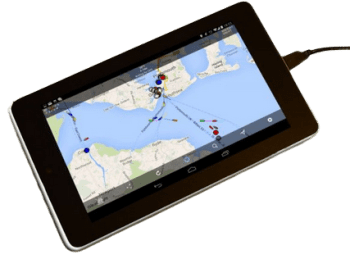
Utilizing a smartphone or tablet as an AIS receiver can significantly enhance a boater's situational awareness. With the right applications, such as MarineTraffic or VesselFinder, users can transform their devices into effective AIS receivers, displaying real-time data about nearby vessels. This setup allows boaters to visualize AIS data overlaid on electronic chart displays, which is crucial for monitoring vessel traffic and avoiding potential collisions.
These AIS receivers can connect to onboard systems, providing comprehensive information such as vessel traffic service details and alerts for nearby vessels, as well as help transmit their own position. However, it's essential to remember that while these applications can be useful, they depend on mobile data coverage and may not always offer the same reliability as dedicated AIS transponders. Hence, combining these tools with traditional AIS systems can maximize safety and navigation efficiency.
Real-Time Vessel Tracking with AIS
As an added safety benefit, real-time vessel tracking through AIS websites, such as MarineTraffic, offers an excellent way for friends and family to follow a boat's journey. This technology transforms what could be anxious days or weeks of waiting for occasional radio updates into an engaging experience where family members can track daily progress, monitor weather conditions along the route, and live vicariously through the traveler's nautical adventures.
FAQs
Is AIS Better Than Radar?
When comparing AIS to radar, each system has its unique advantages and limitations. AIS signals provide clear identification of vessels, allowing for easier tracking of smaller vessels that may not be visible on radar. This feature is particularly beneficial in busy harbors or during low visibility conditions.
On the other hand, while AIS relies on vessels being equipped with the system, radar can detect any object within its range, regardless of whether it is transmitting AIS signals. However, radar systems can be more complex to interpret, especially for inexperienced users.
Ultimately, both AIS and radar serve complementary roles in maritime navigation. The International Maritime Organization encourages the use of AIS alongside radar, as this combination enhances situational awareness and helps boaters make better-informed decisions to avoid collisions.
Can I share AIS data?
Yes, you can share AIS data. Many online AIS tracking platforms and apps encourage boaters to contribute AIS data from their vessel’s AIS transponder or receiver. To do this, you typically need to use software or a device that can forward your vessel’s AIS data stream over the internet. Popular options include AIS Dispatcher (for Windows and Linux), Boat Beacon (for mobile devices), and DataHub by PredictWind. Then, configure your software to send AIS data to the desired service (such as MarineTraffic, AISHub, or ShipXplorer). By sharing your AIS data, you help expand the coverage and accuracy of vessel tracking services for everyone.
Is AIS required for recreational boats?
AIS is not required for most recreational boats, but it is highly recommended for safety, especially in busy or coastal waters.
Do I need an AIS transponder or is a receiver enough?
A transponder broadcasts your position to others; a receiver only lets you see other vessels. For full safety and identification, a transponder is recommended.
We hope you've found this article useful. If you've additional questions, please don't hesitate to contact our product experts at (800) 426-6930.