Easy 3-Strand Eye Splice Step-by-Step Instructions

There comes a time in the life of every boater when they desperately want a specific length of line with a permanent loop at the end of the rope rather than just a knot – commonly referred to as an “eye splice”. Maybe you want to create a mooring line at a specific length, or perhaps it will be part of your anchoring bridle. You can also use an eye splice to form the rope around a thimble – giving it added strength when attaching it to a shackle, chain or wire rope.
By splicing the loop at the end of your line (instead of using a knot) you are making your loop considerably stronger (and safer). This article will give you the information you need to create your own eye splice with a 3-strand rope, whether nylon, polyester, or polypropylene. If you're a beginner, this is one of the simplest splices there is, so it's a great place to start! We also have articles for creating an eye splice with Class I double braid line or a rope to chain splice for your anchor rode, if you're interested.
Preparation
When splicing, it's important to make sure that your technique is good to preserve the rope strength for the splice – especially if you're a beginner. As you go, take time to refer to our tutorials and make sure you keep all your strands nice and tight and that your tucks lie neatly, since the rope can lose strength if the strands are twisted or laid incorrectly.
Before you start, it's a good idea to gather everything you will need – including a splicing fid, or marlinspike, tape, scissors, or sharp knife, a Sharpie marker, whipping twine and some sort of lighter or torch (such as the Ancor Mini Pocket Torch) along with the 3-strand rope you want to splice. If you plan to add a thimble make sure it's handy too.
Ready….Set….Splice!
-
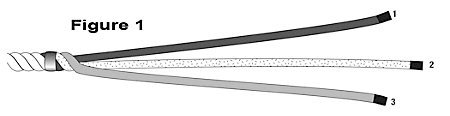
Prepare the Rope: From the end of your rope, count back approximately 16-20 “twists” or strands – it's always better to have a little extra than to run out of line – so don't skimp here! Apply a piece of tape at that point and then unlay the strands from the bitter end back to this point. You should have 3 strands – tape the bitter end of each strand (to prevent it from unraveling) and label each one with the Sharpie marker as 1, 2, and 3 (figure 1).
-
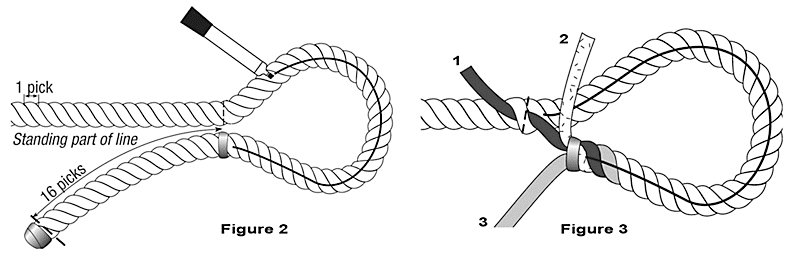
Form the Eye: From the taped end, form a loop the size you want and then mark a line around the standing part of the line (figure 2 below) to create the eye of the finished splice.
-
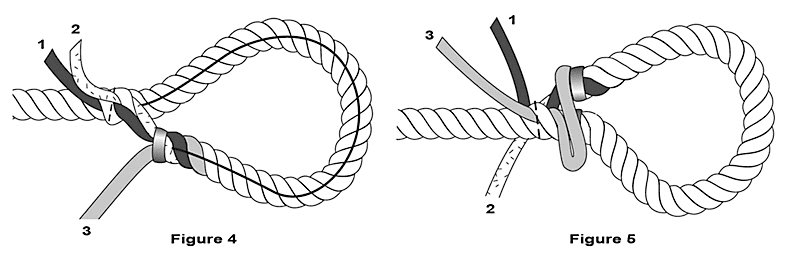
Begin the Splice: Note the mark around the standing part of the rope – your individual strands will tuck under these marks. Tuck the first tucked strand #1 under the nearest marked spot (figure 3 above). Then tuck strand #2 under the marked spot behind strand #1 (Figure 4 below). Turn the entire piece over. There should be 1 strand left on the standing part of the line that does not have a working strand under it. Tuck strand #3 under this strand – continuing to tuck counter to the “lay” or “twist” of the rope. You've just completed your first round of tucks (figure 5 below), so remove the masking tape and tighten the tucked strands if necessary.
-
Continue Tucking: Continue tucking the taped strands down the standing body of the rope. Each tuck should skip OVER the third strand below and then tuck UNDER the next strand. When you've tucked all three strands you've completed a full tuck. All tucks should go right to left, so it may help to keep flipping everything over to avoid confusion.
-
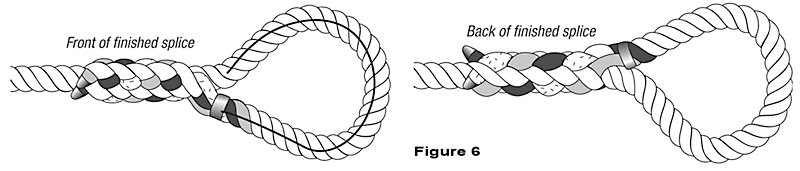
While tucking, it's common for the free strands to want to untwist – not good! Take care to keep the natural twist in each strand as you are tucking – don't let them untwist or unravel. Complete a minimum of 4-5 full tucks – keeping each one nice and tight, but not so tight that you distort the lay of the line – the strands should flow smoothly through each tuck (figure 6 below). For towlines and other long-term or critical applications, we recommend you perform 6-7 tucks.
-
Finish the splice: Professional-looking rope work is distinguished by its tapered finishes. After your final round of complete tucks, gradually reduce the bulk by cutting away a portion of each strand before tucking. Some splicers prefer to eliminate one strand completely in the final round, then half the remaining strands in the next. Sometimes it can help to lightly roll the splice back and forth while pressing down with your hand to smooth it out a bit. Once you've completed all your tucks, trim off the excess strand that's left, and you're almost done! Some splicers also like to use a butane torch to lightly melt the end of each strand to help keep the strand in place.
-
The final step: After you've completed your 3-strand eye splice with its carefully tapered finish, there's one final step that separates amateur DYI work from professional seamanship: the whipping. Even the most perfectly tapered splice can begin to separate over time.
Whipping is the process of binding the end of a splice with small twine or thread to prevent fraying and unraveling. A well-whipped splice is the mark of quality rope work.
Begin wrapping the long end of your twine around the rope, leaving a small loop in the twine. Make sure the starting end of the twine is exposed to allow for tightening the loop later. Work from the splice toward the bitter end. Each wrap should be tight and even, with no gaps between turns. The key is consistent tension—tight enough to grip firmly, but not so tight that you distort the rope's natural shape. Continue wrapping until you've covered approximately 1.5 times the diameter of the rope. For a 1/2-inch rope, this means roughly 3/4 inch of whipping length. Thread the working end through the loop you created at the beginning. Now pull steadily on the buried end (the one you left sticking out at the start) until the loop disappears under the wrapping.
Cut both ends close to the whipping, leaving just enough to ensure they won't pull through under load. Give the whipping a final check by running your fingers along its length—it should feel smooth and uniform with no loose turns.
Advanced Techniques: The Thimble Eye Splice
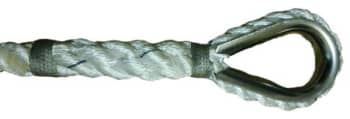
Fisheries Supply carries a wide variety of 3-strand lines and thimbles perfect for use with this splice, as well as all the splicing tools you may need as you begin to do your own splicing.
Splice Maintenance
Since the safety of your boat may depend on the condition of this splice, we highly recommend you check the splice regularly to make sure it's in good condition, and remake the splice if there is ANY evidence of chafe, wear or unraveling. As you've just learned, it's pretty easy to complete – so check and remake as often as needed!
FAQs
What are common mistakes to avoid when doing a 3-strand eye splice?
Common mistakes when performing a 3-strand eye splice include not completing enough rounds of tucks (you need a minimum of three to five, depending on how slippery the rope material is), twisting or crossing strands incorrectly, applying inconsistent tension, and failing to secure the splice properly. Additionally, neglecting to check for frayed or damaged strands can lead to a weak connection. Always make sure that you use correct measurements before you start the splice.
How strong is a 3-strand eye splice compared to a knot?
A properly made 3-strand eye splice maintains roughly 85–95% of the rope’s original strength, while many knots reduce strength to 55–60%. The splice’s gradual transitions minimize stress points, making it much stronger and safer than most knots
How do I size a thimble for my rope splice?
Select a thimble that matches your rope’s diameter. The eye size should be at least 2.7 times the diameter of the object over which it will fit to prevent excessive stress at the throat. Proper sizing prevents rope wear and ensures maximum strength.

We hope you've enjoyed this guide on Eye Splicing with 3-Strand Line, but if you have any questions – please don't hesitate to contact our splicing experts at (800) 426-6930.