Marine Antennas
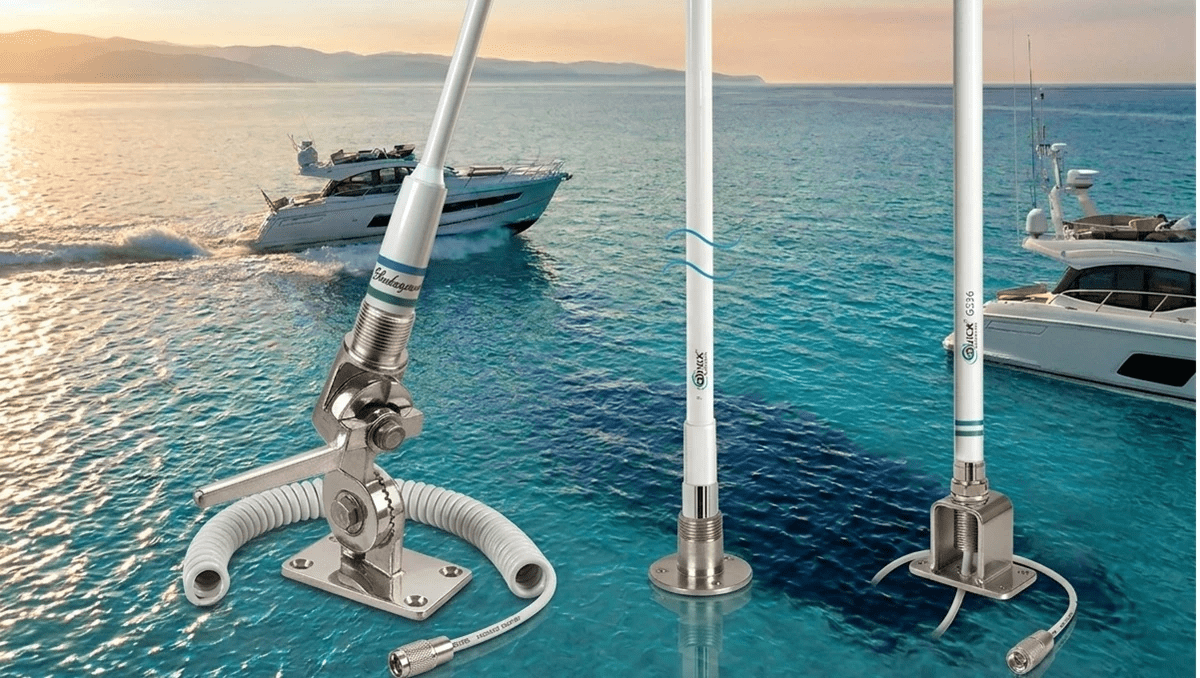

Deciding on a marine antenna can quickly become a morass of technical jargon – overwhelming even the most knowledgeable boater. But considering that a VHF radio is only as good as the marine electronics antenna that supports it, it's important to understand what you are buying. Below is a simple overview of the main points that boaters should consider when purchasing a marine antenna.
Key Takeaways: Marine Antennas
- Height and Range: VHF communication operates on a "line of sight" principle; mounting an antenna higher (such as on a sailboat masthead) significantly increases signal range over the horizon.
- Antenna Gain (dB): Higher gain (e.g., 9dB) focuses the signal beam for greater distance but can lead to signal fading.
- Selecting by Boat Type: 8-foot, 6dB antennas are the standard recommendation for 20–35' powerboats, while masthead-mounted whips are ideal for sailboats due to the height advantage.
- Coaxial Cable Quality: Use RG-58 for cable runs under 20'; for longer runs, low-loss cables like RG-8X or RG-213 are required to prevent significant power loss.
- AIS Compatibility: Boaters using Automatic Identification Systems should select antennas specifically tuned to 162 MHz (like the Morad VHF-159 HD-AIS) for optimal situational awareness.
- Mounting Integrity: Larger antennas (10'+) require upper support clamps placed at specific intervals to prevent structural failure.
- Maintenance and Grounding: Proper grounding protects against electrical surges like lightning, while regular inspections and cleaning with mild soap prevent corrosion and signal noise.
Antenna Length
The height of the antenna plays a crucial role in determining the range of the signal. VHF waves travel in what is known as the line of sight, and the higher the antenna, the farther it can see over the horizon. With this in mind, it is essential to consider the boat and its communication needs when selecting an antenna length.
Sailboats:
Generally, because they have a mast, sailboats have a 3' - 5' antenna mounted at the masthead. Even with their short length and low gain, the height advantage of the masthead mount gives these antennas great range.
Powerboats:
Most powerboats from 16' to 25' in length use a “standard” 8' antenna with an extended frequency range up to 162 MHz for VHF and NOAA Weather, while bigger vessels can have larger antennas with more gain. Be sure to allow room to lay the antenna down, if necessary, for clearing low bridges or covered slips. Your mounting arrangement should also be very sturdy to avoid damage to both the boat and antenna when underway in rough seas. The right accessories for marine antennas are crucial for optimal performance and functionality. For example, when choosing a marine digital antenna, it is important to consider the type of connector used. A Marine Fiberglass VHF Antenna with a molded PL 259 connector is a popular choice among boaters due to it's durability and compatibility with all other VHF radios.
Antenna Gain (Db and Mhz)
After placing the antenna as high as practical, the next way to increase the range of your radio installation is to increase the gain of your antenna. Gain is measured in decibels (dB); generally speaking, the higher the gain, the greater the range. Marine antennas don't radiate energy equally in all directions – the signal “beam” is concentrated in the horizontal plane, parallel to the water. Gain can be thought of as a measure of the “focus” of this beam and its available energy. The energy travels further if the focus is narrow (high dB), like a lighthouse. However, a narrowly focused signal beam may rise above or fall below the intended target in heavy seas, causing signal loss or fading. Although lower gain antennas have a less focused signal and a shorter range, boats that roll or heel significantly often install them to ensure that some portion of the signal beam always points toward the target antenna, even when heeled or rolling.
9 db 3 db 6 db
Typical Radiation Patterns
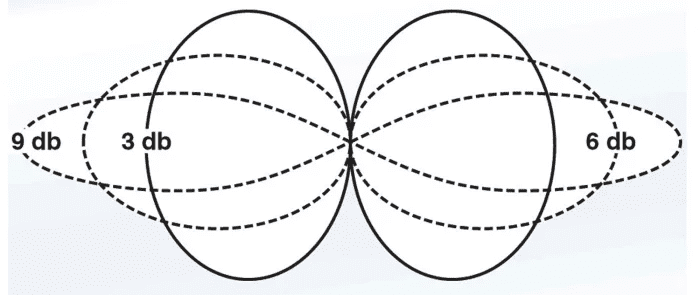
(Radiating antenna is at center; horizontal axis of diagram is parallel to the water's surface; boat is not heeled.)
Increased gain ratings almost always mean taller antennas. The structural integrity of the mounting installation and the antenna itself must be balanced against the quest for greater range. Sailboats and small, lightweight powerboats, which roll excessively in heavy seas, normally do not use long antennas with gain ratings above 6dB. The more stable the platform of a vessel, the higher the gain that can effectively be used. For boats ranging from 20 to 35 feet in length, it is recommended to use an 8-foot, 6dB antenna. This type of antenna provides less range than a 9 dB antenna, but it is also less susceptible to the effects of pitch and roll.
Mounts
There are many styles of mounts available to suit your particular application and support needs. An upper support clamp is necessary if you are using a two-piece antenna system greater than 10' in length. For antennas 14' to 18', the upper clamp should be 3' to 5' from the bottom. For antennas of 18' to 23', the upper clamp should be 4' to 8' from the bottom. Positioning the upper clamp too high or too low can significantly increase the potential for structural failure, so it's important to get this right.
Cable (is coax better?)
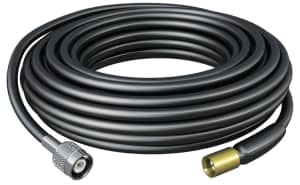
For optimum performance, the cable connection should be kept as short as possible, and the connections should be high quality and as few in number as possible. If you have to make a new connection, you must use high-quality fittings and install them correctly. A poor connection can lower your transmitting power by a factor of 10 or more, so take the time to do this right.
Low Angle Radiation
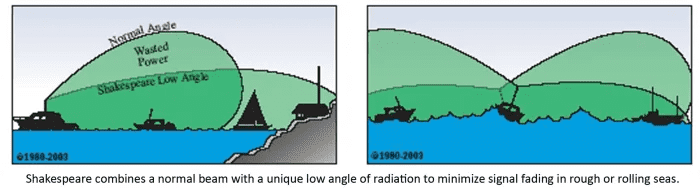
While phased 1/2-wave collinear elements are the standard in high performance, high gain antennas, collinear phased 5/8-wave antennas, such as those made by Shakespeare, offer an increased level of performance by concentrating the radiated signal closer to the horizon, allowing for minimized fading and increased range, even during excessive vessel roll in turbulent seas. This is something you should look for when selecting a fiberglass VHF antenna. The Shakespeare VHF marine antennas, such as the Classic, Galaxy, and Phase III models, are known for their superior performance. These antennas are designed with a combination of coaxial cable, brass, stainless steel, and copper to ensure maximum efficiency. The digital antenna is an excellent choice for marine applications due to its advanced technology and reliable signal reception capabilities.
AIS-Compatible Marine Antennas
For boaters utilizing AIS (Automatic Identification System) technology, selecting an AIS-compatible marine antenna is vital for optimal performance. AIS antennas are designed to work seamlessly with VHF radios, allowing vessels to transmit and receive crucial navigation information, enhancing safety and situational awareness on the water. These antennas, like the Morad VHF-159 HD-AIS, typically operate at a frequency of 162 MHz, specifically tailored to work with AIS systems.
What to Buy

-
For a “Good” antenna, choose from their Classic Series, which provides quality performance for a reasonable price. These antennas are designed to provide basic communication and navigation capabilities for the widest variety of vessels.
-
Shakespeare's Galaxy Series is the next step up and has long been revered as the industry standard for both performance and beauty with top-notch materials and hand assembly. These “Better” antennas can be relied upon for high performance and extra durable construction, along with the high-end electronic features in a high-quality, but fairly priced, antenna.
-
But when only the “Best” will do, Shakespeare's Phase III Series features the most sophisticated electrical engineering levels, performance, and durability available today. These extra heavy-duty antennas are completely foam-filled (which isolates the radiators from vibration and moisture – helping the antenna last longer), have silver-plated elements (that actually improve with age), and stranded, high-quality tinned copper inner conductors, which maximize signal strength. These high-strength fiberglass antennas with aircraft-grade coatings that ensure a high-gloss, non-yellowing protective finish, are unsurpassed in the industry.
Here is a comparison of some of the top-selling marine antenna models that boaters frequently choose for their vessels:
| Model | Height | Gain (dB) | Material | Key Features |
|---|---|---|---|---|
| Shakespeare 5206-N | 8 ft | 6 | Fiberglass | Durable, weather-resistant |
| Shakespeare 5101 Centennial VHF Antenna | 8 ft | 6 | Chrome-plated brass | Ideal for small center console fishing boats. |
| Morad VHF 156 Deluxe | 3 ft 3 in | 3 | Stainless steel whip | For masthead mounting on sailboats and high-speed power boats |
| Digital GV30 - AIS/VHF & GPS Antenna | 8 in | High gain GPS element | Fiberglass | Combination AIS/VHF and GPS antenna |
FAQs
What is the difference between VHF and UHF marine antennas?
VHF antenna signals operate at a lower frequency, with longer transmission waves – meaning the waves can travel longer distances, even following the curve of the earth – but the signal will generally not pass through structures. This makes VHF perfect for outdoor needs, such as calling boat to boat out on the open water, but not so good for metropolitan areas with lots of structures that would break up the transmission signal.
UHF antenna signals operate at higher frequencies with much shorter wavelengths – so while they don’t travel nearly as far (more of a straight line), they pack more punch in the quality of the signal and can penetrate structures – making them better for indoor or urban needs where there are more things to interrupt the wavelength. It’s worth noting that VHF antennas tend to be quite large and bulky – making them less portable in general, while UHF antennas can be very small – making them more portable. Also note that in most cases, these two signals cannot work together as they operate in very different frequency ranges.
Are there any maintenance tips for keeping my marine antenna in good condition?
To keep your marine antenna in good condition, regularly inspect it for any signs of damage or corrosion. Clean the antenna regularly with a mild soap and water solution, and avoid using abrasive materials. Additionally, ensure that all connections are secure and tighten any loose components as needed.
Does a marine radio antenna need to be grounded?
A marine radio antenna generally needs to be grounded to ensure safety and improve performance. Proper grounding provides a path to dissipate electrical surges such as lightning strikes, protecting both equipment and people onboard. It also reduces electrical noise, resulting in clearer radio communication. On boats, grounding typically involves bonding the antenna and coax shield to underwater metal parts like the keel or grounding plates, creating an effective radio frequency (RF) ground.

We hope this article has helped you choose the right antenna for your boat. Buying a marine radio antenna can be intimidating, but we hope this article has helped you understand how to choose the right antenna for your boat. But,
if you still have questions or require additional assistance, please don't hesitate to contact our product experts at (800) 426-6930.