Rocna Anchor Information and Sizing
Complete Peace of Mind
How many times have we been at anchor when the wind turns or blows harder than expected, and we find ourselves praying that our anchor will hold fast? Every boater wants the peace of mind that their anchor is going to keep them safe while they sleep, even if the weather changes dramatically.
After cruising for over 100,000 nautical miles, a New Zealand cruiser named Peter Smith felt sure he could build a better anchor than the options available – and he set out to prove it. Released in 2004, after years of testing and tweaking, the result was the Rocna anchor – the best multi-purpose anchor on the market.
What makes it work?
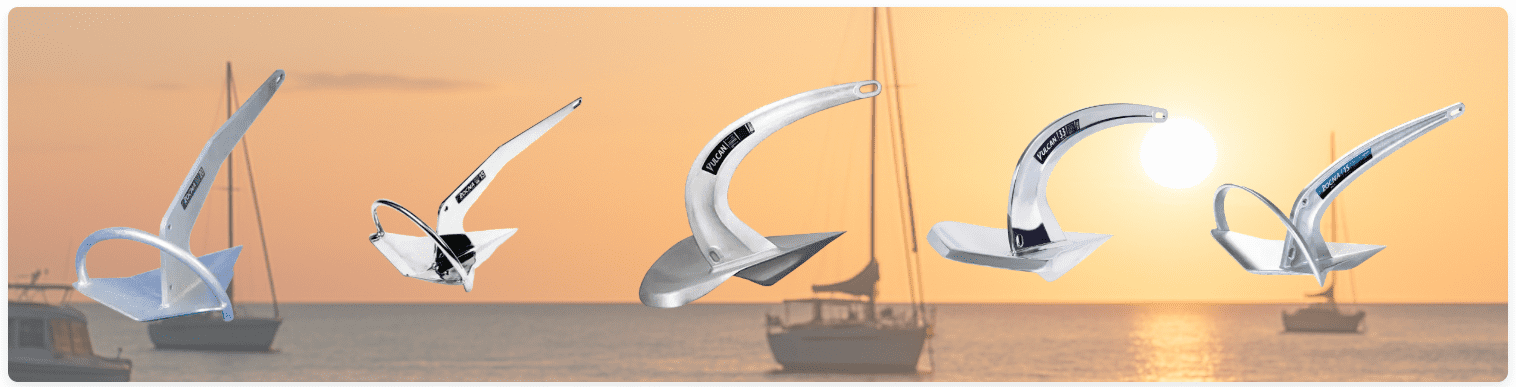
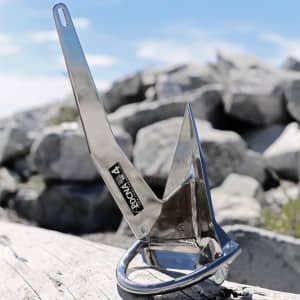
The biggest change Peter made from old-style anchors was the addition of a roll-bar, which helps the anchor turn over – positioning itself into the proper setting angle as soon as it hits the seabed. The Rocna also has setting skids (which keep it in the proper position while it's setting) and a sharp, chisel-like tip that cuts into the seabed, burying the anchor quickly and efficiently. In addition, a concave fluke gives the greatest holding power to secure your boat, even with a 360-degree wind shift, no matter what the seabed consists of. Lastly, the steel shank is designed so that the anchor self-launches and self-stows on the majority of bow-rollers.
Independent tests by publications such as Cruising World, Practical Sailor, and SAIL have all shown that this new-generation Rocna anchor consistently outperforms more traditional anchor designs in a variety of seabeds.
Striving for perfection – the Vulcan
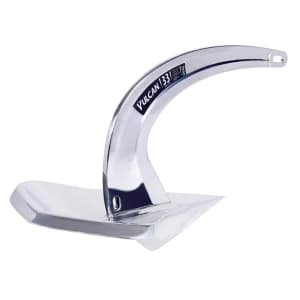
While Rocna anchors have developed a near cult following with their users, there were still some boats that had difficulties accommodating the roll-bar design on their bow – particularly powerboats with a bow pulpit. So Peter got back to work on a new design, released in the beginning of 2015 – the Vulcan anchor - available in both stainless or galvanized. This new anchor capitalizes on already finely tuned design elements, infusing many of its elder sibling's proven performance advantages, while featuring a unique new combination of shank and fluke geometry. The biggest difference is what they call the roll-palm™ at the rear of the fluke. This feature allows the Vulcan anchor to self-right on the seabed without the use of a roll-bar. This is assisted by the V-bulb™ which extends the fluke ballast downward to gain maximum leverage and efficiency – that directly equates to more holding power and security.
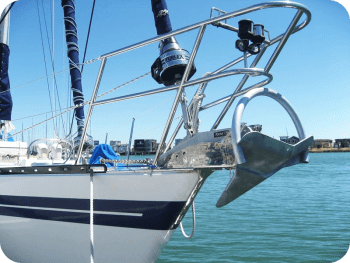
The omission of a roll-bar along with a carefully designed shank profile allows for a snug fit on the bowsprits and bows of a widely expanded range of vessels. In addition to the use of high-tensile steel, shank strength is optimized by a unique I+V profile™ shank design, granting improved resistance to bending courtesy of a computer-optimized I-beam geometry. This not only makes the shank stronger, it also improves setting performance with a lower V edge, which cuts into the seabed and minimizes resistance to a deep and secure burial. To top it off, the new design still encourages self-launching and self-stowing upon retrieval on the majority of bow rollers – making life easier for boaters everywhere.
The theory is great – but does it really work?
We have quite a few employees that love to rave about their Rocna – one of them has definitely put it to the test. She and her husband are currently out cruising, having left in the fall of 2012 to circumnavigate. While home recently for a visit – she raved about how happy they were with their Rocna and told us the following story…
"While we have more stories than I'd like of when the Rocna has saved our bacon, the most recent one happened last October. We anchored in a great little bay in Fiji, but unfortunately, the winds turned overnight, which meant the anchorage was completely exposed to both the wind and the open seas. As the night progressed, the wind began to build and it was soon blowing 20-25 knots – directly into the anchorage. The chop also began to build, and by about 4:30 AM we were experiencing 4-6 foot waves in the anchorage. The boat was hobby-horsing like mad – we knew we had to get out of there – but we had to wait until there was enough light to navigate as Fiji (while beautiful) is poorly charted and has reefs everywhere.
To make matters worse, we were anchored just off a reef – so if we dragged, we would be in big trouble. For the next two hours the bow of the boat was crashing up and down in the waves – 4 feet out of the water one second and 2 feet below the water the next – it was complete madness. Finally, it was light enough out to raise the best anchor and move. Not only did our trusty Rocna hold us through an incredibly rough night – it also released easily just when we needed it to. We've been cruising now for three years, and I will not trust my boat to any other anchor. I highly recommend a Rocna anchor to anyone that plans to spend time on the hook in their boat."Okay – I’m convinced – but will it fit my boat?
If you need help figuring out which model will best fit your boat, check out the full anchor dimensions for each size or the multitude of “boat fit cases” with photos and other information at the “Rocna Knowledge Base” – a great place to look for similar situations to your own, and also refer to our helpful sizing guide.
Sizing Your Rocna Anchor
There's a Rocna or Vulcan anchor to suit just about any vessel, including larger sizes. To choose the correctly sized anchor, find your vessel's length in the column on the left, then track across that row until you find the first column with a displacement (in tonnes) the same or larger than the displacement of your vessel. Once selected, follow the column to the top where the recommended Rocna or Vulcan anchor is indicated. For reference: 1 t (metric tonne) = 1,000 kg = 2205 lbs and 1 meter = 3.28 feet. The rows at the bottom of the chart give equivalent anchor weights in pounds and kilograms, recommended chain sizes, and fluke areas.
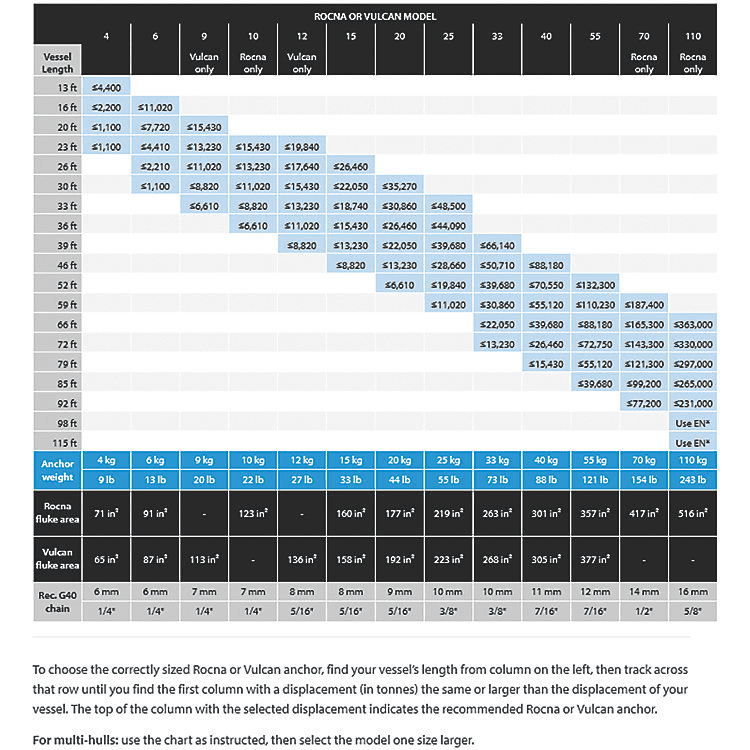
If your boat's weight falls in between two columns, it's best to give preference to the larger anchor model. In addition, a relatively high displacement or high windage vessel should consider choosing a larger anchor, while a smaller anchor may be more appropriate for especially light-displacement boats.
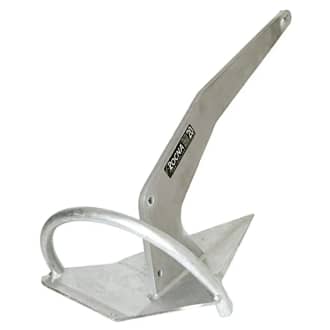
While this sizing may seem a bit conservative, Rocna's recommendations are designed to provide an anchor that can accommodate a wider range of vessels and is adequate for use in even the most challenging conditions.Calculations are based on 50 knots of wind, associated surge, and soft, moderate holding bottom conditions into which the anchor has set. For multi-hulls: use the chart as instructed, then select the model one size larger.
So if you want to sleep like a baby, even when it's blowing like stink outside, an appropriately sized Rocna will provide holding power in excess of what most manufacturers recommend in a wide variety of conditions. Still not convinced? Just walk down the dock until you find a boat with a Rocna on the bow and ask the owner if they're happy with their purchase. You'll be sure to get an earful of how the Rocna has helped them sleep peacefully at anchor.
Real-World Performance and Endorsements
The performance of Rocna anchors is not just theoretical; it has earned accolades from seasoned sailors across various conditions. Its high tensile steel construction provides exceptional holding power, allowing for reliable anchoring even in challenging seabeds, such as soft mud, kelp, and hard sand. Additionally, the anchor comes with a lifetime warranty, a testament to its exceptional quality. User endorsements highlight the anchor's ease of use and efficient retrieval mechanisms, making it a favored choice. The meticulously designed shank and roller ensure a snug fit on a broader range of boats, solidifying its reputation as the best anchor choice.
Related Products & Accessories
FAQs
Why are Rocna anchors shaped the way they are?
The unique design elements of anchors, particularly those of the Rocna, play a crucial role in their functionality. The shape is meticulously engineered to optimize anchoring efficiency, allowing for better penetration into various seabeds. The combination of a well-angled shank and a concave fluke ensures that the anchor can bury itself securely, providing maximum holding power.
What to look for in a good anchor?
When selecting the best anchor for your boat, several key factors should be considered. First and foremost is holding power, which is essential for keeping your boat secure in varying conditions. A good anchor should be able to dig in quickly and hold firm against wind and tide changes. Additionally, ease of use is vital; the best anchor should self-launch and stow effectively, ensuring that deploying and retrieving it is a hassle-free experience.
Are there any limitations or drawbacks to using Rocna anchors?
While Rocna anchors are highly efficient, they can be heavy and may require more effort to handle compared to lighter options. But the pros outweigh the cons, which is essential for a good night sleep at anchor.
Does Rocna offer a stainless steel anchor?
Yes, Rocna offers stainless steel anchors. These are available in various sizes and feature a mirror-polished stainless steel finish, offering both aesthetic appeal and extended service life. The stainless steel models are designed with the same high holding power and durability as the galvanized Rocna original versions, but with added resistance to corrosion and a premium appearance.
We hope you've found this article on Rocna and Vulcan anchors helpful, but if you have any additional questions, please don't hesitate to contact our safety experts at (800) 426-6930.